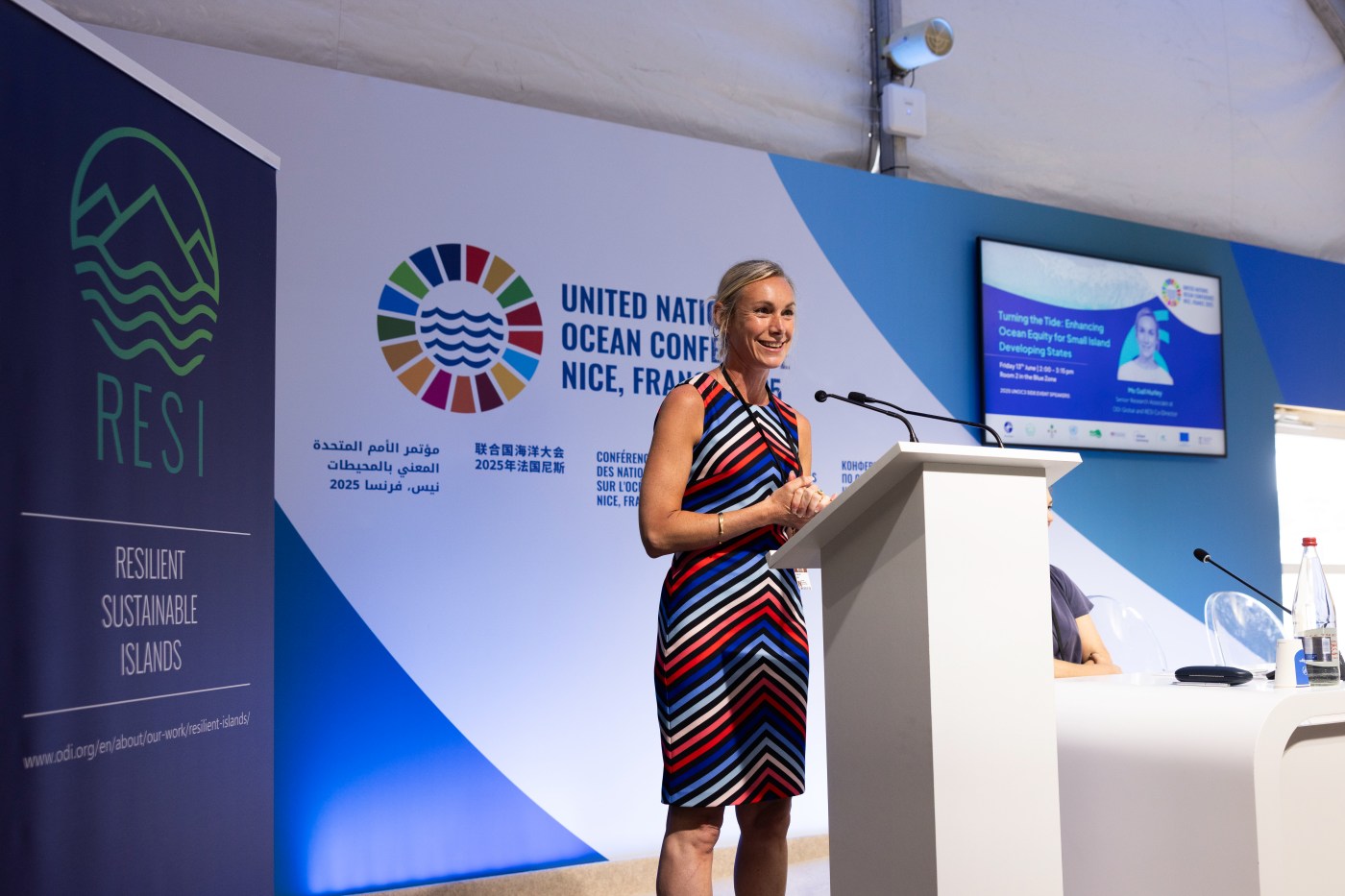
This paper was written for the Resilient and Sustainable Islands Initiative (RESI) at ODI-Global. It was originally published by them in June 2025.
Small Island Developing States (SIDS) depend heavily on the ocean for their livelihoods, economies and climate resilience. Yet they face stark and growing inequities in how ocean resources are accessed, governed and financed. A new briefing paper from ODI Global’s Resilient and Sustainable Islands Initiative (RESI) calls for bold action to place equity at the heart of the international oceans agenda – and ensure SIDS can thrive as stewards of the sea.
Despite their size, SIDS are ocean giants — custodians of vast Exclusive Economic Zones and biodiversity-rich waters. But when it comes to reaping the benefits of the blue economy, they face barriers to fully participating in and benefiting from marine innovation and investment. Countries with greater financial and technical capacity are typically better positioned to access these opportunities, while SIDS remain particularly vulnerable to ocean-related risks such as pollution, overexploitation and climate change.
Our latest briefing paper sheds light on the three dimensions of ocean inequity faced by SIDS: economic, environmental and governance-related. It also highlights inspiring examples where SIDS have challenged these structural imbalances – from blue bonds and marine protected areas to leadership in international negotiations.
Ahead of World Oceans Day, and as the international community gathers at the 2025 United Nations Oceans Conference (UNOC3), this paper makes a compelling case for reimagining ocean policy and investment through an equity lens.
Key recommendations
The paper sets out five key recommendations to enhance ocean equity and ensure SIDS can equitably benefit from, and sustainably manage, their ocean resources:
1. Put equity at the heart of the international oceans agenda
Incorporate equity into all ocean-related funding, investment and governance strategies, backed by better data and deeper partnerships with SIDS-based researchers.
2. Scale up support to SIDS for economic diversification in the ocean economy
Expand access to high-tech sectors such as marine biotechnology and offshore renewables through capacity building, technology transfer and tailored financial support.
3. Allocate more Official Development Assistance (ODA) to Sustainable Development Goal 14 (SDG14) and to SIDS as custodians of ocean biodiversity
SIDS receive insufficient ODA for SDG14, putting them at heightened risk from climate impacts and biodiversity loss. Some SIDS are ineligible for ODA and others suffer from high fluctuations in funding allocations. We need to consider a minimum ODA allocation, with more equitable and stable funding allocations across SIDS and SDG14 targets.
4. Innovative approaches to financing sustainable ocean-based economies in SIDS
Learn from innovative approaches already seen in SIDS like Belize and Palau by scaling up tools like blue bonds, debt-for-marine conservation swaps and user fees to unlock sustainable finance for ocean protection and inclusive economic growth.
5. Negotiations and implementation support for SIDS on oceans governance
Provide negotiation support, technical assistance and binding commitments to to capacity building, financial support, technology transfer and fair access to marine genetic resources. This is to ensure SIDS are able to be active and equal participants in shaping the future of our oceans.


Leave a Reply